The numbers haven’t changed the game: each year, more and more spots open up in design preparatory programs while artistic fields at university are fully booked. And in this disrupted ecosystem, we now encounter parallel admissions, schools recruiting self-taught individuals, and numerous competitions. Between barely ajar doors and long queues, future designers navigate by sight.
The landscape of artistic courses resembles a maze. Faced with selection, promises of personalized support, and all the uncertainties about what comes next, high school students sometimes proceed cautiously. Choosing a path has never seemed so complex.
Design Prep After High School: What to Really Expect?
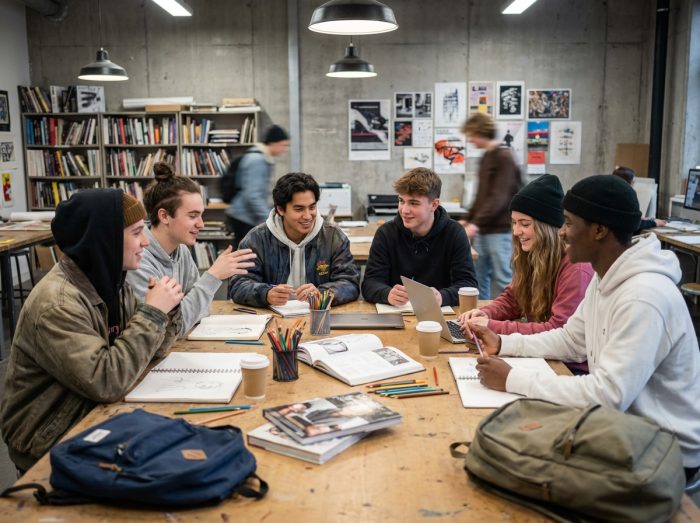
Joining a design prep program means stepping into a world where every detail matters and expectations rise significantly. The tone is set from the first weeks: a mix of practical workshops, drawing sessions, artwork analyses, and group projects. Here, there’s no question of fading into the background: you manipulate, you dare, you start over. Very quickly, the pace accelerates: personal research, portfolios, critiques, and self-reflection. You discover the profession but, more importantly, you learn to shape your perspective, defend your ideas, and sometimes endure criticism.
The famous leveling year, the manaa, for those in the know, structures this pivotal year. The basics are reviewed: working with volume, colors, perspective, art history, graphic design, and spatial design. The goal? To equip each student to tackle a solid artistic training. The teachers often come from the field; they stimulate individuality and encourage students to assert their style.
In practical terms, a year in an artistic prep program covers several things:
- Progressive mastery of fundamental techniques, from sketchbooks to software, including composition and layout.
- Establishment of a substantial portfolio, a valuable key to passing entrance exams for higher education schools.
- Discovery of industry codes, and preparation for interviews or tests to avoid missteps on exam day.
The example of doing a design prep at ESMA illustrates this dynamic well: attentive environment, active pedagogy, an already established network. In these classes, the mix of profiles and the density of teachings make the year a true springboard, whether aiming for a prestigious school or a direction towards applied arts.
Paths to Train in Art and Design: An Overview
France is multiplying ways to access design and the arts. From high school, here are the options available to candidates. For many, prep remains the preferred choice to strengthen their foundations and approach higher art schools. However, some prefer to get straight to the point through an integrated program, a degree, or a bachelor’s focused on applied arts or graphic design.
Higher art schools, whether national or regional, maintain their reference status. Gaining access to these institutions requires passing an exam: a convincing portfolio is necessary, and above all, you must arrive prepared. The learning process often extends over three to five years, punctuated by workshops, internships, group projects, and real-world confrontations with the job market. The ambition: to prepare agile, autonomous, and creative professionals.
To clarify, here are the main pathways available after high school:
- Preparatory classes establish a work method, a solid visual culture, and a true capacity for critical analysis.
- Higher art and design schools offer several years of study, involving experimentation, research, and concrete collaborations.
- Applied arts programs favor quick integration, with a focus on graphic design, spatial design, or product design.
It’s impossible to think only of Paris: cities like Lyon, Marseille, or Nantes also display a high level of demand. The choice is made based on desires, commitment, and the appetite to confront a competitive sector and quickly join a professional network.

After Design Prep: Perspectives and Trajectories
Artistic prep is not just an additional box on a resume. It’s a matrix: you refine your choices and gauge the expectations of the sector. Admitted through an interview, portfolio in hand, students must convince of their progress: the ability to invent, defend a position, and surprise.
The classic path after this gateway? Joining a higher art school or a program in applied arts, which opens up specialties as diverse as graphic design, scenography, illustration, photography, or visual communication. Some lock in their choice towards object design or graphic design, while others pursue more advanced degrees.
In practice, the preparatory year offers various concrete perspectives:
- Facilitating access to art schools, whether public or private, provided all resources of the prep have been utilized.
- Developing a professional network early on, through internships, events, and meetings initiated by the school.
- First steps into the real world: exhibitions of work, participation in workshops or workshops, immersion in the daily life of the sector.
The design sector in France, from major cities to regions, sets the bar high. This journey requires perseverance and boldness. But on this road, you cultivate your autonomy, learn to innovate and adapt, and experience both collectivity and independence. Those who navigate these early stages open up horizons where creativity often rhymes with adventure.