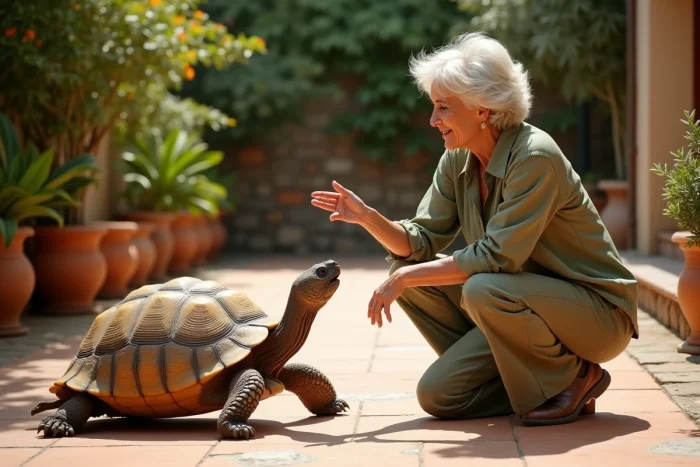
When you place a strawberry in front of a Hermann’s tortoise and it moves towards the hand holding it rather than the fruit, you start to question things. This scene, mundane for many tortoise owners, raises a topic that science is taking increasingly seriously: the ability of tortoises to recognize their owner.
Facial recognition in tortoises: what the Lincoln study shows
A study published in 2025 in the journal Animal Cognition by the team from the University of Lincoln (UK) tested the recognition of human faces in Russian tortoises (Agrionemys horsfieldii) in captivity. The protocol was based on conditioning: presenting the owner’s face and that of a stranger, then measuring the animal’s reaction time.
Result: the tortoises reacted faster to their owner’s face than to that of a stranger. This is not a feeding reflex, as the tests were conducted without visible food. The study marks a break from the anecdotal observations that had circulated on forums for years.
Before this publication, reliance was mainly on testimonials from owners. Knowing whether a tortoise recognizes its owner according to Animaloo remained a question without solid scientific answers. The Lincoln study provides the experimental framework that was lacking.
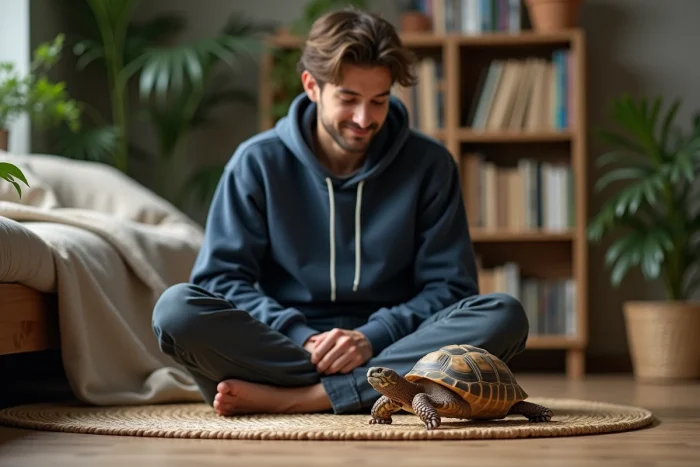
Land tortoise and sensory memory: sight, voice, smell
Reducing recognition to sight alone would be a mistake. In practice, experienced breeders and owners observe that the tortoise uses multiple sensory channels to identify a person.
- Sight: tortoises distinguish colors and shapes. They recognize the silhouette and gestures of their caretaker, especially if the caretaker always adopts the same posture to feed or handle them.
- Voice: certified breeders who are members of the French Association of Tortoise Breeders (AFET) report that Hermann’s tortoises over 20 years old in outdoor enclosures specifically approach their main caretaker during repeated vocal calls. This behavior is not observed with other voices.
- Smell: tortoises have a developed sense of smell. They associate a person’s scent with their care routine (baths, feeding). Changing soap or hand cream can temporarily disrupt this association.
We therefore speak of multimodal recognition: the tortoise combines several sensory inputs to “decide” whether the person in front of it is familiar.
What the tortoise really recognizes: its owner or a source of comfort
The question deserves to be asked directly. A tortoise that approaches you does not love you in the mammalian sense of the term. It associates you with a set of positive stimuli: food, warmth from hands, routine of warm baths, absence of threat.
A recurring testimony on enthusiast forums summarizes the situation well: the tortoise comes to its owner first, but if a stranger feeds it for several weeks, it eventually adopts the same behavior with them. This is not emotional attachment comparable to that of a dog. It is associative learning, reinforced by repetition.
Territorial fidelity and routine
The 2025 AFET report describes an interesting phenomenon: “territorial fidelity.” Hermann’s tortoises in outdoor enclosures do not just recognize a human; they integrate this recognition into their mental map of the territory. The main caretaker becomes a spatial reference as well as a sensory reference.
In practical terms, this means that moving a tortoise to a new enclosure with the same owner results in a shorter adjustment time than entrusting it to an unknown caretaker in its usual enclosure. The tortoise recalibrates its environment around the person it knows.
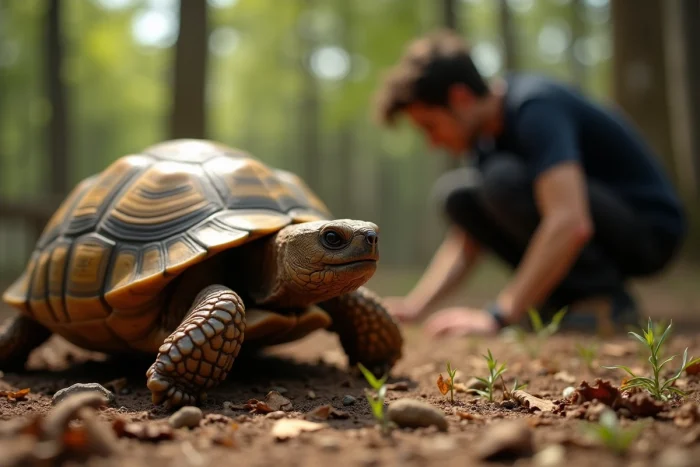
Strengthening the bond with your tortoise: the gestures that matter
If you want your tortoise to reliably identify you, consistency is more important than the quantity of interactions. Here’s what works based on feedback from breeders and documented behavioral observations.
Always feed by hand, at least partially. Placing food on the ground and leaving does not create any association between you and the meal. Offering a piece of dandelion or endive leaf directly allows the tortoise to combine your scent, your silhouette, and the food reward.
Talk to your tortoise in a consistent tone. Feedback varies on this point, but several breeders note that tortoises accustomed to a calm and repetitive voice show less retraction into their shell over the weeks. The tone matters more than the words.
Maintain regular warm baths. This is a moment of direct contact, skin against shell, where the tortoise associates warmth and hydration with your presence. Once or twice a week is sufficient for adult Hermann’s tortoises.
What breaks the bond
Sudden handling, frequent changes of caretaker, and loud noises cause stress that cancels out weeks of positive conditioning. A stressed tortoise no longer recognizes anyone; it systematically retracts, regardless of the human in front of it.
The recognition of the owner by a land tortoise relies on slow, sensory, and contextual learning. It is not affection in the sense we understand with a mammal, but it is measurable, reproducible behavior that is now documented by research. For an animal whose brain has hardly changed in millions of years, this is a remarkable achievement.