
A volume of 4m3 represents a limited loading space, often offered in the form of a small van or trailer. Before booking a vehicle of this size for a move, it’s essential to measure precisely what can fit inside, and especially what will need to be left behind. The question is less about the number of boxes than about the combination of furniture-boxes-items that can actually fit in this space.
Actual dimensions of a 4m3 van and loading constraints
Small vans follow a common logic: a loading space that is relatively long, but with a limited interior height, often below 1.50 m. For a 4m3, we generally talk about a length of around 2 m, a width of about 1.60 m, and a height that prevents stacking more than three or four standard boxes.
This geometry has direct consequences. A tall piece of furniture (bookshelf, wardrobe) must be laid down, which immediately takes up all the length on the floor. Flat items (mattresses, disassembled table tops) stack well, but as soon as an irregular volume is introduced (bike, office chair), wasted spaces multiply.
To concretely visualize the possibilities offered by the 4m3 volume on Be At Home, we find that the limiting factor is rarely the weight, but rather the arrangement of items in a low and narrow space.
Typical contents of a 4m3: comparative table by scenario

Two people moving a 4m3 will not fill it in the same way. It all depends on the profile: a student with few pieces of furniture, a person in transition storing some of their belongings, or as a supplement to a larger truck. The table below presents three concrete cases.
| Scenario | Furniture | Boxes | Miscellaneous items |
|---|---|---|---|
| Student room | Desk, chair, small TV stand, low shelf | 8 to 10 standard boxes | Suitcase, lamp, sports bag |
| Supplement to a large move | Disassembled kitchen table, two folding chairs | 12 to 15 boxes of books/dishes | Vacuum cleaner, small appliances |
| Very furnished studio (high limit) | Single mattress, slatted bed base, low dresser | 5 to 7 boxes | Duvet, pillows, wrapped mirror |
In the first scenario, the height is utilized to stack boxes around the low furniture. In the third, the mattress and bed base alone take up nearly half the volume, drastically reducing space for the rest.
Bulky furniture and 4m3 volume: the real limits
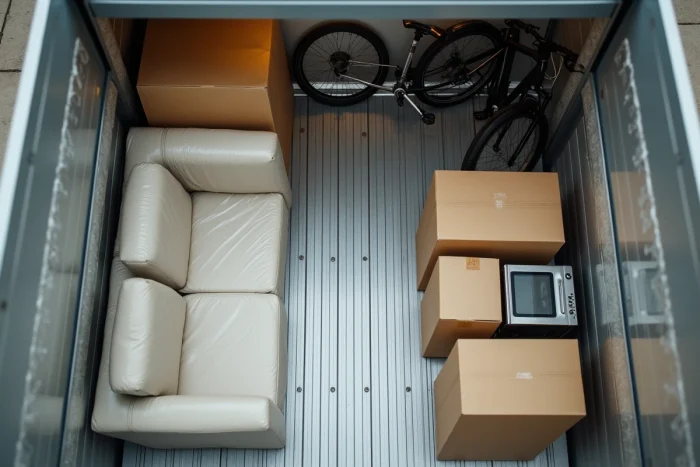
A 3-seater sofa alone represents about 1.3 m3, which is almost a third of the total capacity. Once this type of furniture is loaded into a 4m3 van, there is only room left for a few boxes wedged into the gaps. The same logic applies to a large wardrobe or a double bed with a base.
The classic trap is underestimating the unit volume of bulky furniture. Here are the pieces that saturate a 4m3 as soon as they are combined:
- A convertible sofa or corner sofa, whose irregular shape creates dead spaces that are impossible to fill
- A non-dismantlable 2-door wardrobe, which must be laid down and blocks the entire width of the floor
- A refrigerator or washing machine, which are heavy and occupy a compact but rigid volume
Two bulky pieces of furniture are enough to fill a 4m3 without leaving room for boxes. If the move includes a sofa and a large appliance, a larger vehicle must be planned or two trips organized.
Optimizing the loading of a 4m3 van: what makes the difference
The usable capacity of a moving truck never exactly matches its advertised volume. Between wasted spaces at the corners, protections around fragile items, and the shape of the furniture, rarely more than 80% of the theoretical volume is utilized.
To get the most out of a 4m3, three principles can significantly change the game:
- Systematically dismantle everything that can be (table legs, shelves, bed frames) to obtain stackable flat pieces
- Load the heaviest and flattest items at the bottom, then fill the side gaps with soft boxes (clothes, linens, rolled duvets)
- Use the hollow spaces of open furniture (drawers of a dresser left in place and filled with small items, inside of a microwave stuffed with socks)
This optimization work transforms a wobbly load into a dense stack. The difference between a “well-filled” 4m3 and a “half-empty despite everything we tried to put in” 4m3 almost always comes down to the prior dismantling of furniture.
Boxes: realistic quantity for a 4m3
A standard moving box occupies about 0.06 m3. In theory, one could fit more than 60 in a 4m3 space. In practice, a 100% box load typically hovers around 40 to 50 units, because the shape of the boxes does not allow for perfect nesting and the limited height blocks stacking beyond three or four levels.
As soon as boxes and furniture are mixed, the quantity of boxes drops rapidly. With a desk, a chair, and a dresser in the vehicle, there is room for a maximum of about ten boxes.
4m3 compared to other moving truck volumes
A 4m3 corresponds to a specific and limited need. Below that, we are talking about a car trunk. Above that, 6m3 vans already offer a capacity gain that changes the nature of the possible move.
A 6m3 vehicle allows for the transport of a 3-seater sofa with still some room for boxes and small furniture. In contrast, a 4m3 forces a choice between bulky furniture and the rest of the belongings. It is this tipping point that makes volume estimation so crucial before booking a van.
For a move from a sparsely furnished studio or as a supplement during a larger move, the 4m3 remains a relevant format as long as no bulky furniture is loaded. As soon as a sofa, a double bed, or a large appliance enters the equation, switching to a larger size becomes necessary.