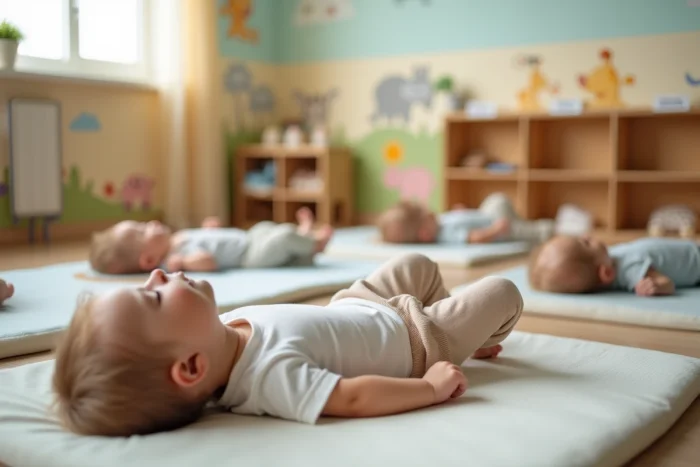
In the preschool’s small section, naptime is part of the school routine. However, French official texts never use the term “mandatory nap.” What they require is an adjustment of school time that respects the biological rhythms of young children, including rest. The distinction between the obligation to sleep and the obligation to organize a rest period changes the situation for families as well as for educational teams.
Rest time and school attendance: two distinct legal concepts
The confusion between naptime and attendance arises from a collision of two regulatory frameworks. The first concerns the obligation of education from the age of three, enshrined in the Education Code since the law of July 26, 2019, for a school of trust. The second pertains to the internal organization of school time, governed by the preschool programs (BOEN special no. 2 of March 26, 2015) and circular no. 2012-202 of December 18, 2012.
Attendance requires the child’s presence during class hours. However, the regulation of the mandatory nap in the small section stems from a misunderstanding: no law or decree compels a child to sleep. The texts require that the school provide an appropriate rest framework, which is very different.
The 2012 circular specifies that “school time takes into account the needs and biological rhythms of young children” and that “rest periods are organized accordingly.” Therefore, the school has an obligation of means (to arrange a space and a rest time), not an obligation of result (to make each child sleep).

Decree of July 26, 2019: organization of the afternoon in the small section
The decree of July 26, 2019, published in BO no. 31 of August 29, 2019, is the most frequently cited text in discussions about naptime in preschool. It does not directly address naptime. Its purpose is to provide exceptions to attendance in the afternoon for children in the small section.
Specifically, this text allows families to request a modification of afternoon hours, subject to the approval of the academic director (DASEN). The child can then be absent some afternoons without this being considered a breach of the school obligation.
What the decree allows and what it does not
- It allows partial absence in the afternoon in the small section, upon request from parents and after validation by the DASEN, not solely by the school principal.
- It provides no legal basis to force a child to sleep during the rest time organized by the school.
- It does not modify the preschool programs or the 2012 circular, which remain the references for the pedagogical organization of class time.
This decree has sometimes been misinterpreted: some families believe it makes naptime mandatory since the afternoon is mandatory. The logic is the opposite. The afternoon is mandatory unless an exemption is granted, and during this afternoon, the school organizes a rest period without being able to impose sleep.
Preschool program 2015: rest as an educational time
The preschool education program, published in BOEN special no. 2 of March 26, 2015, qualifies moments of rest, naptime, and hygiene as “full educational times.” This wording places naptime on the same level as welcome or recess: a structured time, supervised by adults, but not a strictly academic exercise.
The program adds that these times “are organized in this perspective by the adults responsible for them, who provide reassuring benchmarks for young children.” The emphasis is on emotional security and the regularity of the framework, not on the duration or depth of sleep.
Quiet rest or naptime: the teacher’s flexibility
The Scientific Council of National Education (CSEN), in its March 2022 summary “Better Sleep for Better Learning,” provides useful insight. Offering a nap to a child who no longer needs it often disrupts their nighttime sleep. In contrast, naptime for those who still need it does not impact nighttime sleep.
This scientific data confirms the approach of official texts: the school must offer rest, not impose it uniformly. A small section child who no longer sleeps can be directed to a quiet activity after a reasonable period of lying down. The teacher adapts based on what they observe, in conjunction with the ATSEM.
Role of the school principal and the IEN in organizing naptime
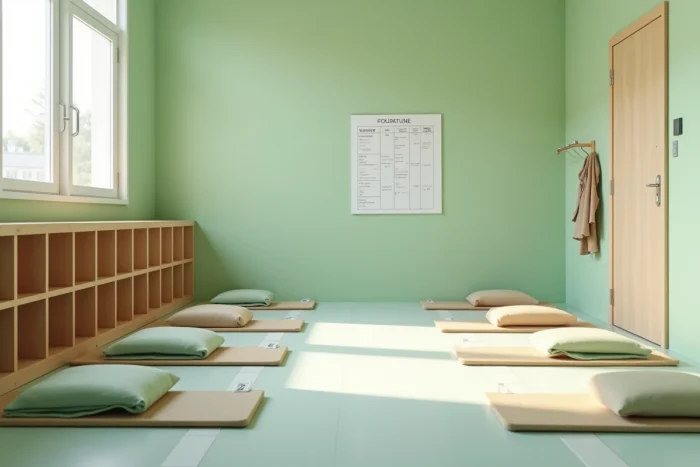
The concrete organization of naptime falls under the school project, validated by the inspector of national education (IEN) of the district. The school principal coordinates the implementation of the rest time, in consultation with teachers and ATSEMs.
In case of disagreement between a family and the educational team (child kept lying down too long, refusal to offer a calm alternative), the hierarchical appeal goes through the IEN. No circular sets a maximum or minimum duration for naptime. Practices vary according to schools, student numbers, and available facilities.
- The school principal organizes rest slots within the framework of the school project, without being able to impose a fixed duration on all children.
- The IEN mediates conflicts and ensures that the arrangement complies with the programs and the 2012 circular.
- The DASEN intervenes only for requests for exceptions to afternoon attendance, as provided by the 2019 decree.
The chain of responsibility is therefore clear: the school organizes, the IEN controls, the DASEN grants exceptions. None of these levels has the power to make sleep mandatory for a given child.
The French regulatory framework clearly distinguishes between the obligation of school attendance and the arrangement of rest time. The texts protect both the child’s right to rest and their right not to be forced to sleep. When a parent receives a message from the school mentioning a “mandatory nap,” the wording does not reflect the applicable law: it is the rest time that is organized, not the sleep that is prescribed.