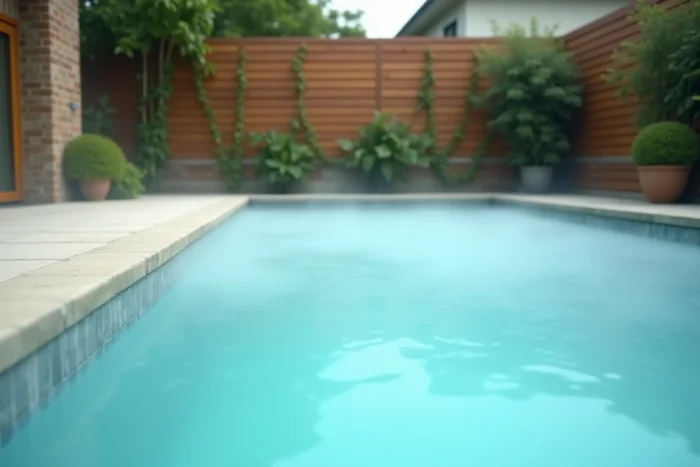
You look at your pool, the water is nice and blue, but you can’t see the bottom. This milky veil that clouds the transparency without turning green is one of the most common problems in season. The usual reflex is to add chlorine, but most of the time, chlorine is not to blame.
Fine turbidity in pools: the role of particles invisible to the filter
The cloudy water of a pool contains suspended particles that are too small for the filter to retain. This phenomenon has a technical name: fine turbidity. It gives that characteristic milky blue tint.
Have you ever shaken a glass of flour in water? The liquid becomes opaque without changing color. In your pool, the mechanism is similar. Residues of polymers, limestone, oxidized metals, or organic matter remain suspended. Their size, often smaller than what a standard sand filter can capture, explains why filtration runs without visible results.
The source of these particles is rarely detailed. Several technical reports from pool professionals in France (published between 2022 and 2024) point to an increasingly common culprit: the multifunction tablets used in excess. These tablets combine chlorine, flocculant, algaecide, and stabilizer.
With overdosing, the flocculating polymers and stabilizer accumulate, creating a turbidity that no longer settles to the bottom. This happens even when the pH and chlorine show normal values on the strips.
To better understand the causes of opaque blue water according to Habiz, it is necessary to distinguish between the trouble related to a chemical imbalance and the trouble caused by an overload of treatment products. This distinction changes everything for what comes next.
pH, chlorine, and stabilizer: identifying the true cause of the bluish trouble
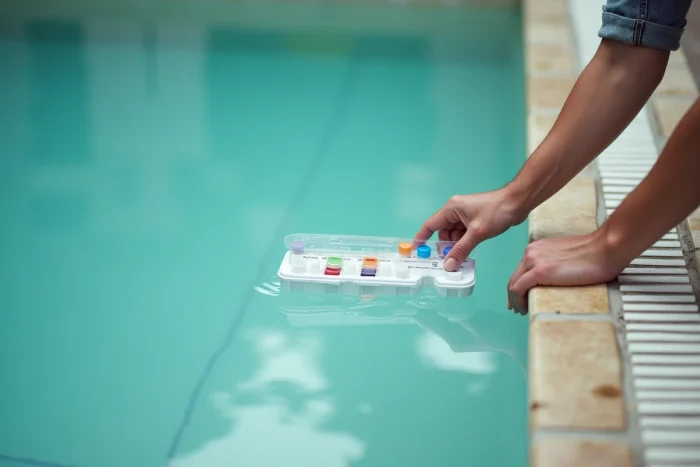
Before pouring anything into the pool, three parameters deserve precise testing with an appropriate kit (not just strips).
The pH, the first suspect to check
A pH that is too high reduces the effectiveness of chlorine and promotes the precipitation of dissolved limestone in the water. This suspended limestone gives exactly that whitish-blue veil. A pH between 7.0 and 7.4 for chlorine treatment is the target range. Above 7.6, chlorine loses a large part of its disinfecting power, and limestone deposits settle in.
The stabilizer, trap of multifunction treatments
The stabilizer (cyanuric acid) protects chlorine from UV rays. But it accumulates over the weeks, especially with multifunction tablets that systematically contain it. Once a certain threshold is exceeded, it blocks the action of chlorine. The water remains blue (no visible algae) but becomes cloudy because disinfection no longer works properly.
The stabilizer cannot be removed by chemical treatment. The only real solution is to partially drain the pool to dilute its concentration, then start again with unstabilized chlorine.
Dissolved metals
Filling water rich in copper or iron can also cause a bluish cloudiness. The oxidation of copper in contact with chlorine gives this characteristic metallic tint. This case is rarer in city water but common with a borehole or well.
Filtration and flocculation: restoring clear pool water
Once the cause is identified, the correction follows a logical order. Acting out of order (for example, flocculating before correcting the pH) amounts to wasting product.
- First, correct the pH with a pH-Minus or pH-Plus product according to your test result. Wait a few hours of filtration before moving on to the next step.
- If the stabilizer is too concentrated, drain one-third of the volume and refill with fresh water. No chemical product degrades the stabilizer in the water.
- Then perform a flocculation (cartridge or liquid) suitable for your type of filter. The flocculant aggregates fine particles into larger clumps that the filter can retain. Note: cartridge flocculation is reserved for sand filters. With a cartridge filter, use a liquid clarifier.
- Let the filtration run continuously, ideally for at least a full day, until transparency is restored.
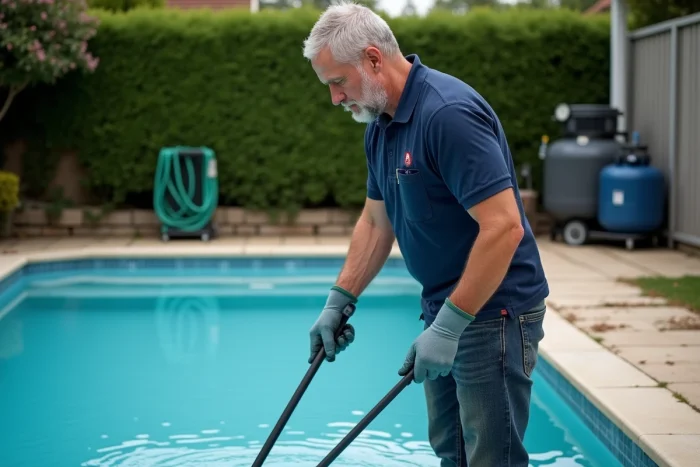
After flocculation, a backwash of the sand filter is often necessary to remove the captured impurities. Check the pressure on the gauge: if it remains high after washing, the filter media (sand or glass) may be saturated and needs to be replaced.
Cloudy water and multifunction tablets: the vicious circle to avoid
The scenario repeats every summer in many private pools. The water becomes slightly cloudy. The reflex is to add a multifunction tablet. The cloudiness persists, so a second one is added. The stabilizer rises, chlorine loses its effectiveness, and the flocculant integrated into the tablets accumulates without precipitating. The more you treat, the cloudier the water remains.
To break this cycle, the most reliable method is to separate the treatment functions:
- Unstabilized chlorine (calcium hypochlorite or bleach) for disinfection
- A dedicated flocculant, dosed separately according to the actual need
- An algaecide used occasionally, not continuously
This approach requires a bit more monitoring than the “all-in-one,” but it allows you to dose each parameter independently. When a cloudiness appears, you know exactly which lever to pull.
Maintaining a pool with blue but cloudy water rarely comes down to a single action. Testing before treating remains the most effective rule to avoid multiplying products without results. An analysis kit measuring at least pH, free chlorine, and stabilizer covers most situations. Cases related to metals require an additional test, available from most pool professionals.