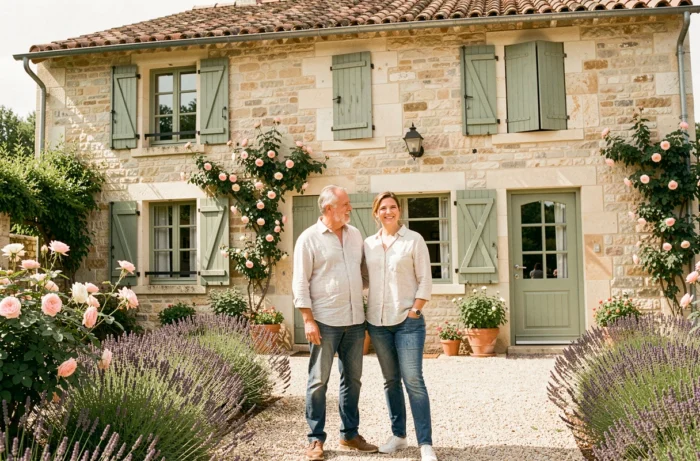
Charente combines a dense stock of old real estate (longères, limestone village houses, farmhouses) and new developments concentrated around Angoulême, Cognac, and La Rochefoucauld. Finding a house in Charente requires mastering a few local mechanisms before starting the first visits.
Electricity DPE conversion coefficient and electrically heated houses in Charente
A technical parameter often overlooked by buyers is the electricity conversion coefficient in the DPE. Currently set at 1.9, it will drop to 1.7 on January 1, 2027, according to an order published on August 26, 2026.
In practical terms, a Charente house heated by electric convectors or a heat pump could see its energy class improve without any work. An E label today could become a D tomorrow.
For a buyer, this changes the negotiation strategy. A house classified E or F in 2026 may be reclassified after January 2027, affecting its rental value and resale ease. Before negotiating down based on the current DPE, checking the main energy source of the property allows for anticipating this reclassification. Listings available on immo-charente.com usually specify the heating method, which facilitates this initial sorting.
Expanded PTZ for new houses: what it changes for Charente
Since April 1, 2025, the zero-interest loan finances the purchase of a new house throughout France, including in rural and peri-urban areas of Charente. This scheme, in place until December 31, 2027, was extended by decree n° 2025-299 of March 29, 2025.
Before this date, the PTZ was reserved for collective housing in certain tight areas. The expansion changes the game for first-time buyers considering construction on land in Charente.
Conditions to check before relying on the PTZ
The PTZ remains subject to income ceilings and only covers a fraction of the total price. It does not replace a personal contribution or a main loan.
- The household’s reference tax income must remain below a threshold that varies according to the geographical area and household composition.
- The PTZ can only finance the primary residence: a secondary residence project in Charente is not eligible.
- The amount of the PTZ depends on the cost of the operation, the area, and the number of occupants, with a ceiling that differs from one territory to another.
Checking eligibility with the bank or a broker before signing a preliminary agreement avoids building a financing plan on uncertain aid.
MaPrimeRénov’ after September 2026: a trap for old houses
Charente is full of stone houses from 1900 to 1970, often poorly insulated. Many buyers include MaPrimeRénov’ in their renovation budget. Since September 1, 2026, the rules have changed significantly.
Decree n° 2026-822 of August 25, 2026, removed several common operations from the “by gesture” pathway: attic insulation, wall insulation, ventilation, and certain solar equipment. The aid is refocusing on the electrification of heating.
For a Charente longère classified F or G, this means that a comprehensive renovation project remains fundable through the supported pathway, but isolated insulation work no longer receives the same support as before.
Adapting the renovation budget to the new landscape
Two reflexes protect the buyer from an unpleasant financial surprise:
- Get quotes for energy renovation work before signing the preliminary agreement, distinguishing what remains eligible for MaPrimeRénov’ and what no longer is.
- Prefer the supported pathway (comprehensive renovation with energy audit) if the house requires several types of intervention, as it remains better funded than the by gesture pathway.
- Do not confuse the theoretical amount displayed on online simulators, often based on old rules, with the actual amount applicable since September 2026.
A renovation budget built on old aids may be underestimated by several thousand euros. Recalculating each item with the current scales is the only reliable method.

Visiting a house in Charente: technical points to check on-site
Beyond the crush for a blonde stone facade or a tree-filled garden, visiting an old house in Charente requires particular attention to three elements that mandatory diagnostics do not always cover in detail.
The first is the condition of the roof and framework. Limestone houses in the region often have old oak frameworks. A healthy framework can be identified by the absence of sawdust on the ground, the rigidity of the joints, and the absence of dark stains on the wood. Preventive treatment costs much less than partial replacement.
The second concerns humidity. Stone walls without a crawl space naturally draw up moisture by capillarity. Signs of efflorescence at the bottom of interior walls, a persistent musty smell, or a crumbling coating indicate a problem that will require specific treatment.
The third point is the connection to sanitation. In rural Charente, many houses operate with non-collective sanitation (septic tank or micro-station). The sanitation diagnosis, mandatory upon sale, indicates whether the installation is compliant. Bringing it up to standard can represent a significant cost that is better integrated right from the negotiation.
The combination of the planned DPE reclassification in 2027, the expansion of the PTZ, and the overhaul of MaPrimeRénov’ reshapes the purchasing conditions in Charente. Each parameter alters the actual acquisition cost. Checking them one by one, before signing, remains the only way to buy at the right price.