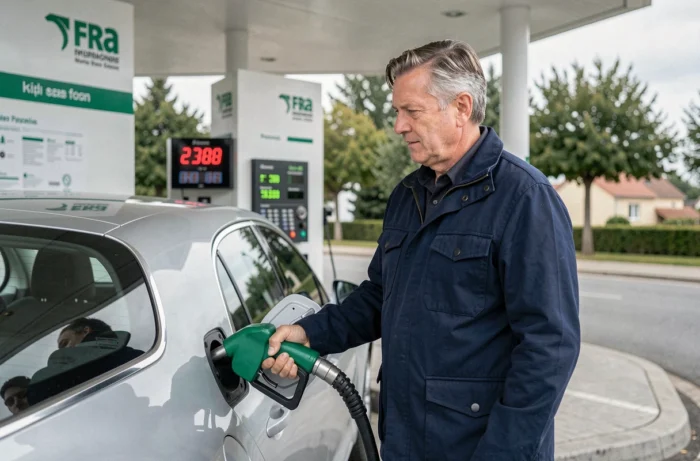
Refueling with hydrogen in France takes less than five minutes. The process is similar to that of a traditional gas pump. However, the amount displayed on the payment terminal holds some surprises compared to the promises made in manufacturers’ brochures.
What the pump bill doesn’t show
Unlike gasoline or diesel, there is no national reference price for hydrogen in France. Each station sets its own price based on its supply method, size, and target clientele.
The price displayed per kilogram only reflects part of the actual cost. A driver who has to travel several dozen kilometers to reach the nearest station spends additional fuel (or electricity) even before connecting the nozzle. With a still limited network, this detour is far from trivial.
In the summer of 2026, around 55 hydrogen stations open to the public were listed in France, according to Conseils Auto. France Hydrogène, on the other hand, counted 50 stations in operation and about fifty projects underway. This difference is explained by the scope considered: some sources include stations reserved for professional fleets, while others include only points accessible to the general public. Therefore, before calculating your budget, check if the nearest station is indeed open to individuals.
To check the price of hydrogen refueling in Paris from a plane, you will find a detailed comparison that complements this data.
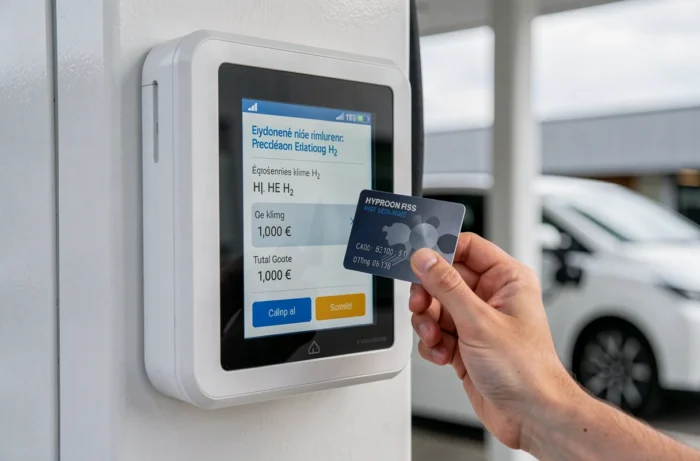
Price per kilogram of hydrogen: the real range in France
The public price displayed at stations accessible to individuals varies from one outlet to another, without a national grid. Hydrogen is a gas compressed to 700 bars in the tank, so the measurement is in kilograms rather than liters. One kilogram of hydrogen contains about three times more energy than one liter of gasoline.
How much to fill a full tank
The two hydrogen car models marketed in France (Toyota Mirai and Hyundai Nexo) come with tanks of a few kilograms. The technology is presented as cutting-edge, but the fuel cost remains comparable to that of a thermal sedan. The difference lies elsewhere, particularly in the purchase price of the vehicle.
Hydrogen, electric, gasoline: cost per kilometer comparison
Comparing only the price of refueling is not enough. The cost per kilometer depends on the vehicle’s consumption, the price of energy, and the frequency of refueling.
| Energy | Cost of refueling (order of magnitude) | Average range | Ease of refueling |
|---|---|---|---|
| Hydrogen | Comparable to gasoline | About 500-600 km | Very limited network (about 55 stations) |
| Electric (battery) | Significantly cheaper | Variable (300-500 km) | Rapidly expanding network |
| Gasoline/diesel | Variable depending on oil prices | 600-800 km | Dense network |
Hydrogen is not competitive solely on energy cost compared to electric. Its advantage lies in the refueling time (less than five minutes) and range, two points that matter for high-mileage drivers or professional fleets.
Why professional fleets often pay less
Contracts negotiated between station operators and fleet managers (buses, utility vehicles, trucks) provide for rates different from the public price. These conditions generally remain confidential, as noted by Truckoo in its analysis of the hydrogen truck market in France.
This mechanism explains why some professional feedback shows lower costs per kilometer than what an individual would pay at the same station.
The real barrier: the purchase price of hydrogen vehicles
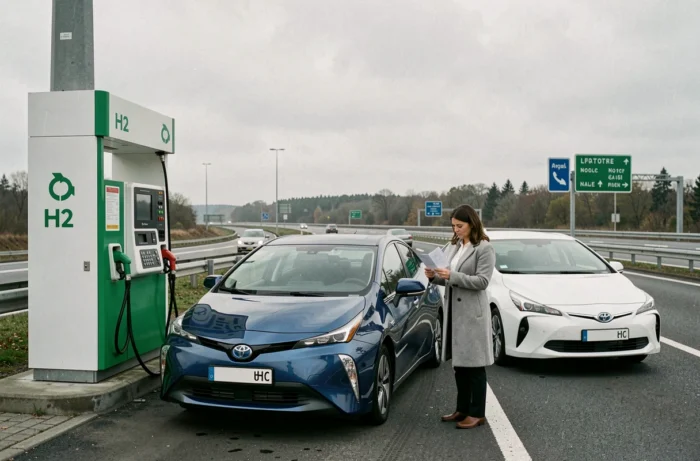
Even though refueling remains affordable, hydrogen vehicles marketed in France are positioned in the high-end segment. The Toyota Mirai and Hyundai Nexo have prices that limit their distribution to the general public.
This additional cost at purchase is explained by the limited production of fuel cells. As long as volumes remain low, economies of scale do not apply. An individual calculating their total mobility budget (purchase, fuel, maintenance) over five years will find that hydrogen remains more expensive than battery electric.
What could change the game
Several factors could lower the overall cost in the coming years:
- The increase in the number of stations, with about fifty projects underway according to France Hydrogène, would reduce detours and improve fuel availability
- The scaling up of green hydrogen production (through electrolysis from renewable energies) could drive down pump prices if volumes increase
- The European AFIR regulation requires member states to deploy refueling infrastructure for alternative fuels, which includes hydrogen for heavy transport corridors
The station network remains the main lock. Without sufficient territorial coverage, even an attractive price per kilogram will not convince individual buyers.
Should we wait before switching to hydrogen
For an individual in 2026, the economic calculation clearly favors battery electric. The cost of hydrogen refueling is comparable to that of gasoline, but the vehicle costs much more and stations remain rare.
Hydrogen finds its place more in professional fleets, heavy transport, and uses requiring high range with short downtime. The price per kilogram is not the issue; it’s the entire ecosystem that still needs to mature.
Monitoring the evolution of the station network in your area remains the best indicator of when switching to hydrogen will become truly relevant in daily life.